
Brown Film or Dark Film? Choosing the Surface Finish
The film on a formwork panel is a wearing surface with a job to do: release concrete, survive handling, and leave a finish the architect accepts. Dongstar Wood offers dark brown film, black film and anti-slip film across the formwork range, in 165 g/㎡ and 130 g/㎡ weights, and the choice between them is a site decision before it is a price decision.
Key takeaways
- Three film surfaces are published: dark brown film, black film and anti-slip film.
- Two film weights are quoted: 165 g/㎡ on the smooth surface and 130 g/㎡ on the lighter option.
- The reuse ceiling is 10–20 times for high-grade panels in concrete pouring projects.
- Thickness is driven by the structure: 18 mm for heavy formwork, with 21 mm and above for bridges and high-load platforms.
What the film actually does
A formwork plywood panel's phenolic film is its interface with wet concrete. It stops the cement paste bonding to the veneer, it carries the abrasion of pouring and striking, and it seals the core against the water that would otherwise reach the glue line. The mill quotes two weights — 165 g/㎡ on the smooth surface and 130 g/㎡ on the lighter option — and the difference is wearing thickness, not colour. A heavier film tolerates more abrasion cycles before the veneer beneath shows through, which is why the smooth 165 g/㎡ surface is the default for poured concrete walls and slabs where the finish matters.
Brown versus black
Dark brown film and black film behave similarly in release and wear; the visible difference is the shade of the panel and the colour it transfers to the concrete. Brown film is the traditional formwork surface and the one most contractors recognise on site; black film reads as the more uniform, more engineered face and is often specified where the formed surface will be left exposed. Neither colour changes the glue, the core or the thickness — the specification that travels with the colour is the film weight, and that is the number to confirm in writing before the order is pressed.
The colour also affects how the formed surface photographs. Dark brown film leaves a warm, slightly textured shadow on the concrete, and that shadow is the one most formwork suppliers use in their reference images. Black film produces a cooler, more even surface that reads as pre-cast rather than poured. For architectural concrete that will be left exposed — columns in a lobby, a feature wall in a retail space — the colour transfer is a design choice as much as a technical one, and the architect should see both films pressed before the order is placed. In production, the colour transfer is consistent across a batch: the same film weight, the same concrete mix and the same curing time produce the same shade every time.
When anti-slip is the right surface
Anti-slip film trades some release behaviour for grip. The textured surface — the wire-mesh pattern the client describes for its anti-slip boards — gives boots and platforms purchase on scaffolding boards, walkboards and access platforms where a smooth film would be a hazard. The same panel still pours concrete; it is simply not the surface you stand on. Where a project needs both, the range separates the jobs: smooth film for the formed face, anti-slip film for the working deck.
The anti-slip surface is also worth specifying on temporary flooring and access platforms during the early phases of a build, when the formwork deck is still the working surface for the structural crew. A smooth film on a wet deck becomes a liability the moment it rains, and the cost of one anti-slip panel is a fraction of the cost of a slip injury. The textured surface does not affect the concrete finish on the opposite face, so a project can use anti-slip on the top and smooth film on the bottom of the same panel without a compromise on either side.
Cores and adhesives behind the film
The film is the face, but the panel behind it decides how many cycles the film gets. Six cores are offered — Birch, Eucalyptus, Acacia, White Hardwood, Rubber and Combi — with Eucalyptus Core positioned at the maximum-strength end and Acacia Core as the high-strength hardwood option. Adhesives cover E0, E1, E2, MR, WBP and Phenolic Dynea, and for formwork the phenolic and WBP classes are the ones that keep the glue line intact through repeated wetting and drying. A film can only cycle as long as the bond beneath it holds.
Sizes, thickness and the twenty-cycle view
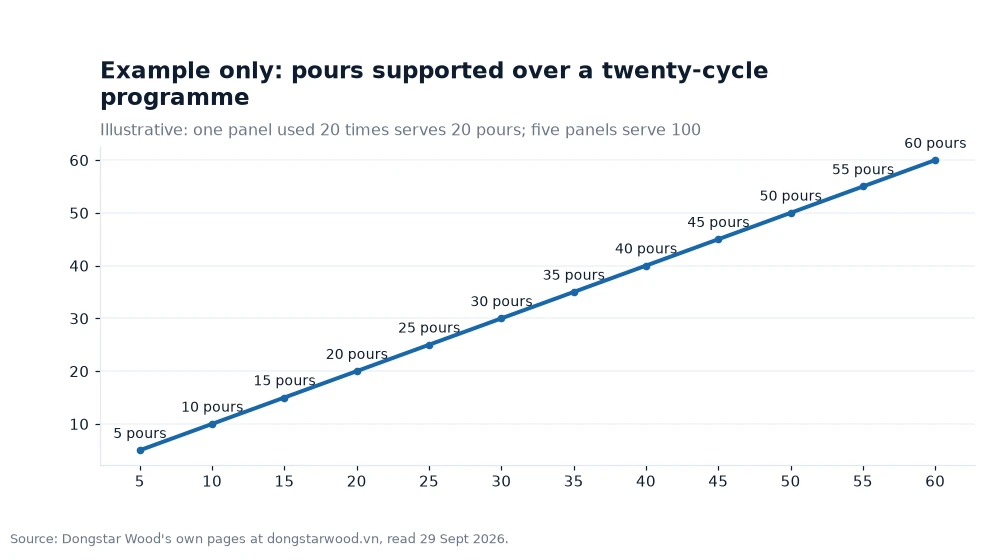
Available widths cover 1500 × 3000 mm, 1250 × 2500 mm and 1220 × 2440 mm, with custom panels up to 1830 × 3830 mm; thickness guidance pairs 18 mm with heavy formwork and 21 mm and above with bridges and high-load platforms. Together these define the formwork specification. The reuse ceiling of 10–20 times is best read as a programme: a Film Faced Plywood panel used 20 times serves 20 pours, and five such panels serve 100 — the arithmetic that turns a sheet price into a cost per pour.
| Surface choice | Published detail | Where it fits |
|---|---|---|
| Dark brown film | 165 g/㎡ smooth option | General poured walls and slabs |
| Black film | Uniform engineered face | Exposed formed surfaces |
| Anti-slip film | Textured grip surface | Scaffolding boards and walkboards |
| Lighter film | 130 g/㎡ | Lighter wear programmes |
| Reuse ceiling | 10–20 times, high-grade | The pours-per-sheet budget |
Worked example: a twenty-pour programme
Example only, using the published figures. A single 1250 × 2500 mm panel covers 1.25 m × 2.5 m = 3.125 m². Used 20 times, it serves 20 pours and delivers 20 × 3.125 = 62.5 m² of contact area; five panels deliver 5 × 20 = 100 pours, which is the client's own illustration of how a small shuttering stock covers a large programme. At the floor of the published range, 10 reuses, the same five panels serve 50 pours and 10 × 3.125 = 31.25 m² per sheet — the film choice and the handling decide which side of the range the project lands on.
Frequently asked questions
What is the difference between brown and black film?
Both are phenolic wearing surfaces; the practical difference is appearance. Brown film is the traditional formwork face, black film reads as the more uniform engineered surface, and the specification that matters with either colour is the film weight — 165 g/㎡ smooth or 130 g/㎡.
When should anti-slip film be specified?
Specify it where people stand or walk: scaffolding boards, walkboards, access platforms and temporary flooring. The textured surface gives grip underfoot, and the same panel still pours concrete when it is used as a formed face.
How many pours should a formwork panel deliver?
The page states that high-grade film faced plywood can survive 10–20 concrete pours. A project's actual count depends on the film weight, the core, the adhesive class and the edge care on site.
From film choice to shuttering stock
The surface you pick is the surface the site lives with for the whole programme, so match it to the work before matching it to the budget. The commercial range covers the interior panels that share the same factory, and the mill's profile confirms the lines, the certifications and the monthly capacity behind every film option. Buyers who choose the film on site conditions tend to hit the reuse ceiling more often than the ones who choose it on price alone.
The measurements discussed were obtained from the mill's website dated 29 September 2026[1].